Explusion Sprinkles
6-9pm Thursday 24th June, at LUVA Gallery
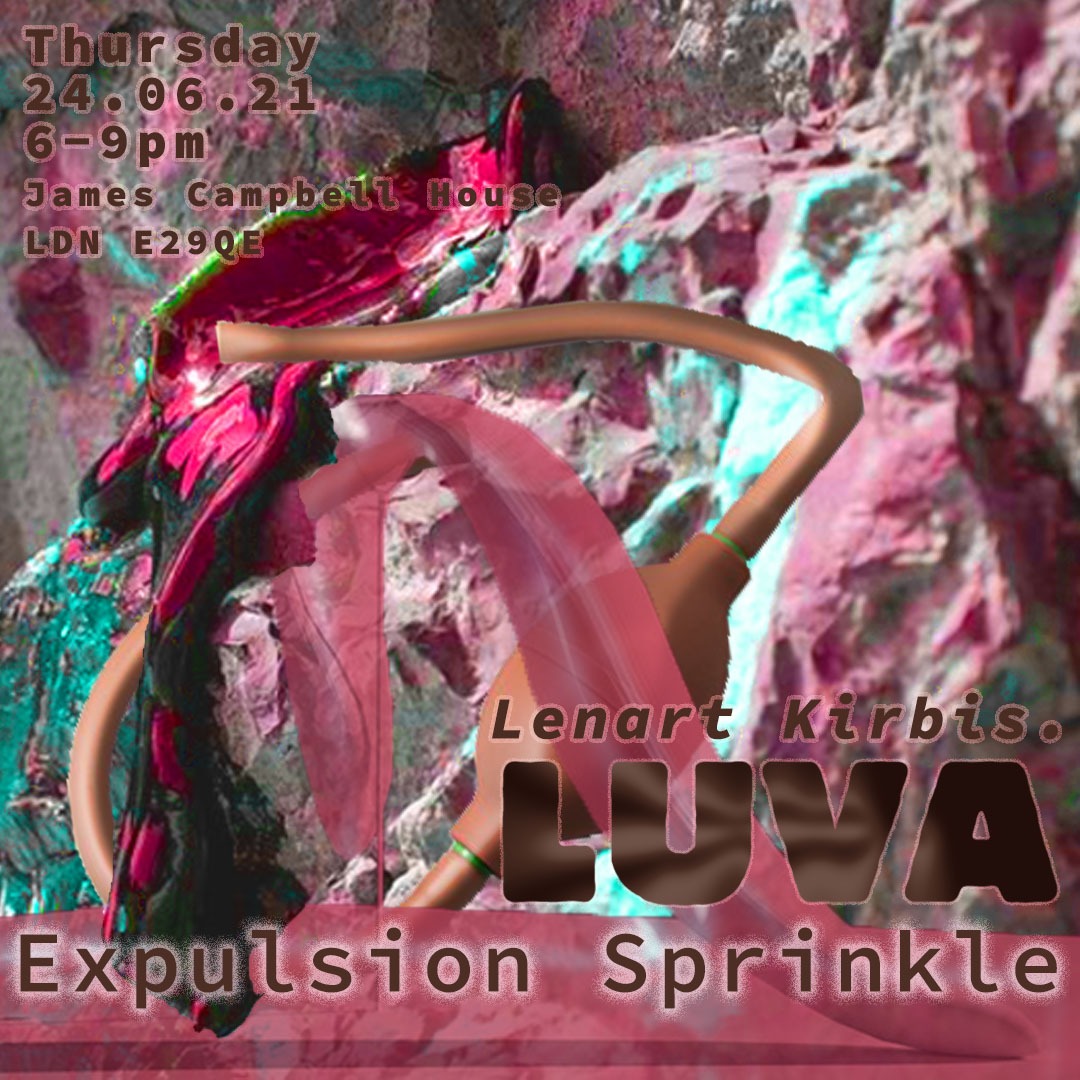
An exhibition by Lenart Kirbis presenting a series of sculptures, inspired and developed from Kirbis' work
and
experimentation with sugar in lockdown #1 situated in a quarry, in Slovenia.
The multimedial work explores topics of simultaneous decay and collapse as well as addressing perseverance
and entrapment, mundaneness in everyday domestic life.



Interview with Lenart
Could you tell us a little bit about yourself?
I am an artist and I predominantly live and work in London. My main interests revolve around
aesthetics of
form and ontology of objects outside the anthropometric context.
How would you define your practice?
Giving up on defining my work seems to be the most difficult part of my current thought
process.
What’s changed for you over the past year?
The pandemic began about half a year after I started my post-university professional path. I
experienced
both sides, not knowing what was going on right at the beginning, then being extremely busy for a few
months
and after that having nothing to do up until about a month ago. This down time was very useful for me,
but I
still cannot wait to return back to our normal way of living.
Have you had to alter your practice or the way that you realize your work to make it visible/ accessible
online?
I tried to avoid making specifically digital work as much as possible. Changing what I do did not
seem to be
the right answer. Instead, I used this time for self-reflection and experimentation.
What does your work aim to say?
My work deals with the paradox one must face when trying to see objects in a non-anthropocentric
context. It
strives to find ways of expressing this abstract concept and delves into finding means of doing
so.
Who are some of the artists you’ve been influenced or inspired by?
I think I have been influenced by the works of Michael Houellebecq, Tristan Garcia and Graham
Hartman. None
of them are visual artists but their works have had the strongest formative effect on my
thinking.
What intrigues you the most by the discovery of a connection or lack of?
I hope I am getting this question right. Accidentally stumbling upon a new connection within my
practice or
a specific body of work is one of the greatest feelings in itself. It often happens spontaneously and
usually sits between the realms of empirical and abstract. Dragging my work from one to another
(palpable to
abstract and vice versa) and wearing them down is an important part of the process. I like leaving
things
and coming back to them at some later point.
Have you previously looked at the processes of attraction, repulsion, and longing within your practice?
Yes. Dealing with assigned meaning and associations is one of my main interests.
Do you see this series developing more into the future, if so what's the next step?
Yes. The shift towards a pre-existing form is relatively unusual for my work. Things I create are
shaped in
accordance with their own material qualities. I am using this opportunity to try something new and play
around with ideas and shapes that make sense but also remain slightly ambiguous.
How do you feel the sublime plays into the work?
When objects are given personalities and human qualities we can start thinking about the narrative.
This
often opens up new possibilities but also deters from the true solitary existence of things.
What are you trying to represent with your use of repetition and clustering?
Repetition is a tool for building a wider gap between the observer and the observed. Clustering
reminds (me)
of 3D renderings. Anyone that has ever spent enough time to learn the very basics or modelling software
will
probably make the connection to particle simulations. This is a relatively new way of seeing -
understanding
our surroundings through the lens, distorted by the digital.
Do you ever experience strong emotive responses from objects found in nature or is it specific to the
man-made/ processed?
I think nature or better, that element of nature that is hard to point to as an object, triggers
even
stronger emotive responses than the artificial. The lack of ability to be fully suspended in a natural
environment is probably why it is so inviting and beautiful.
Do you believe the associations and meaning of an object can be obscured entirety by altering the texture
and the surroundings in which it is situated?
Yes and no. I believe the object maintains its qualities, while its relation to other objects
changes. One
may argue that objects' function or purpose change when placed within a different context. Function and
purpose are concepts used and perpetuated only by the human intellect, or at least that, which is alive.
These two and other similar concepts give false impression of importance and ranking within the
anthropometric system of values. In the most deterministic aspect, they should be seen as mechanisms,
which,
in order to preserve themselves, have to blur our vision.
Lenart Kirbis is a multimedia Slovenian born artist, presently based in London after studying fine art at
Central Saint Martins. Often fluctuating in abstractness and process, Kirbis digital 3D renders are
elemental to and facilitate other physical materiality’s in work, ‘continuous fabrication is an essential
part of my methodology’.
The immersive exhibition ‘Expulsion Sprinkle’ focuses on the multiplication of an emotionally implicative
single object, addressing the human meanings and concurrent feelings of attraction, repulsion and relation
that are attributed with the works presented. Featuring moulded copies adorned in a sugary surface, the
repetitive states nod back to his digital renderings where deviations in scale and randomness become numbers
in settings.
Demanding to be expressed through an array of mediums, the reified objects succumb to the ever-present
tendency to become a body of work, a piece, that is something more than plainly themselves. Part
found-object, part cast - Kirbis illustrates the fragility in context and interpretation of objects, its
visuality becoming a textured blur in relation to us. Thrown into the discourse created by humankind they
become carriers of ideas, nodes for the associations to be attached to, with the intention of arousing our
need for fulfilment.
Kirbis works express concepts based on metaphysical questions throughout carefully chosen mediums and
objects. Attracted by specific forms that remind of bodies or other innate structures found his
surroundings, revisioning contours and manipulating the tangible presence of nearly amorphous masses.